Every engagement I take on starts the same way, and it never starts with a campaign. It starts with an argument about definitions, conducted politely, in a document.
That sounds like a stalling tactic. It is the opposite. The companies that let me do this are running experiments six weeks in. The ones that push past it are still reconciling two numbers three months later.
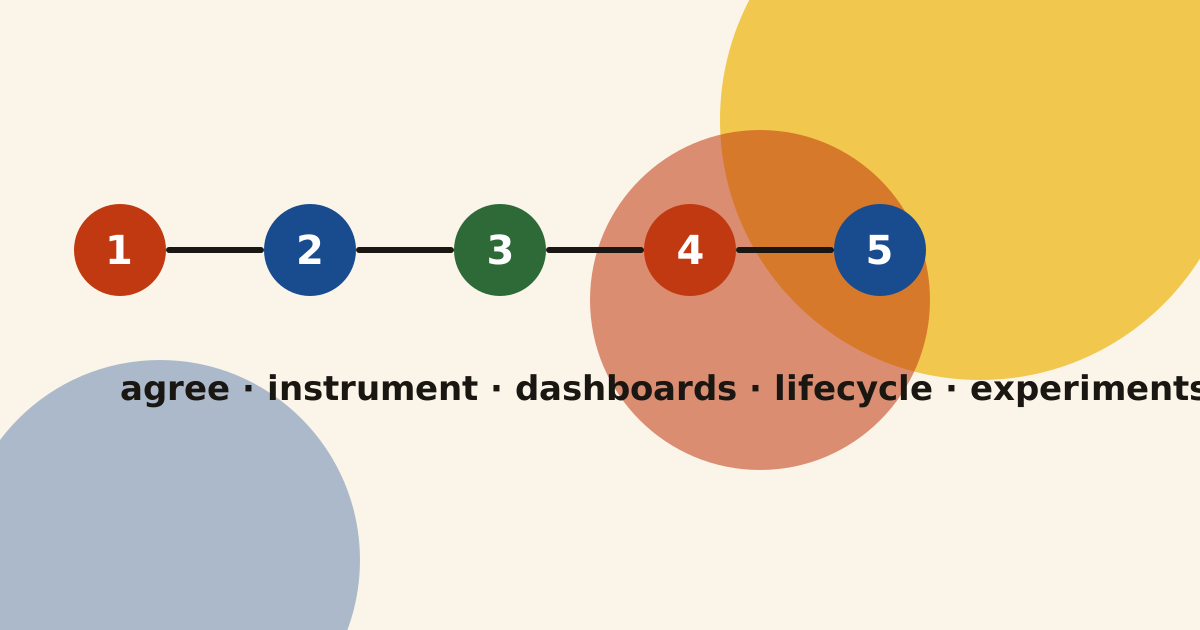
Here is the order.
1. Agree what counts, in writing
Before anything is instrumented, one document gets written and signed off: what a conversion is, what the steps before it are, and what each one is called.
This is boring and it is where the whole thing is won. I have lost count of the companies where the paid team and the product team quote different conversion rates for the same funnel and both are correct, because they are counting different events. Nobody is lying. Nobody wrote it down.
The document is short. A table of events, what triggers each one, what properties it carries, and who agreed to it. If you cannot get your own team to agree on that table, no analytics tool will rescue you.
2. Instrument it — then audit it
Implementation is the easy half. Your developers take the table, push the events, and tell you it is done.
It is not done. The audit is the job.
Every event gets checked against real traffic: does it fire when it should, does it fire only when it should, and is it carrying the properties the table promised. In my experience something is wrong roughly every time — a duplicate fire on a route change, a property that arrives as a string on web and a number on app, an event that never fires on Safari because it was hung off something that gets blocked.
Staging and production disagree more than anyone expects, which is why the audit runs twice: once before release and once after.
3. Dashboards, and only then
A dashboard built on unaudited data is worse than no dashboard, because people believe it.
Once the events are trustworthy, reporting takes days rather than weeks, and it can be narrow: the funnel, the steps, the drop-off. Looker Studio for the stakeholder view, the product analytics tool for anyone who needs to ask a question the dashboard did not anticipate.
One thing worth knowing if you are setting up now: GA4 moved new conversion events to data-driven attribution by default in October 2025, retiring last-click as the standard. If you are comparing this year against last year and the numbers have shifted without your spend changing, that may be why. Check which model your key events are on before you conclude anything about a channel.
4. Lifecycle, built off the same schema
Now the CRM and the automation, and crucially built from the same event table.
The most common mess I inherit is a lifecycle stack that was built in a different quarter by a different person using different definitions. The emails trigger off one idea of “activated” and the dashboard reports another. They drift, quietly, and by the time anyone notices, six journeys depend on the drift.
Build them in the same fortnight or you will be reconciling them forever.
5. Experiments, last
Only now is there any point testing anything, because only now can you tell whether a test won.
1/ Growth Loops are the new funnels - some thoughts by myself, @onecaseman, @kevinakwok, and @andrewchen.
The plan you write at the end of this sequence should describe a loop, not a funnel: what brings people in, what they do, and how that creates the next person. Brian Balfour’s Reforge essay on growth loops is still the clearest version of that argument, and it only works if the events in step 1 exist.
And the backlog writes itself. When you can see which step loses people, the list of things worth trying gets short, obvious and arguable — which is exactly what you want a backlog to be.
Why the order is not negotiable
Each step depends on the one before it being true. Dashboards on unaudited events produce confident nonsense. Lifecycle journeys on a different schema produce contradictions. Experiments without a trustworthy funnel produce results you will argue about rather than act on.
You can skip steps. Plenty of companies do, and they get somewhere. They just cannot tell you which part of what they did was responsible, which means they cannot do it again on purpose.
measure it once properly, then go and grow it
Questions people ask
How long does this take at a seed-stage startup?
Do I need a data warehouse?
Which tool should I pick for product analytics?
Written September 2026. Platform facts checked at the time of writing; if you are reading this much later, check them again.