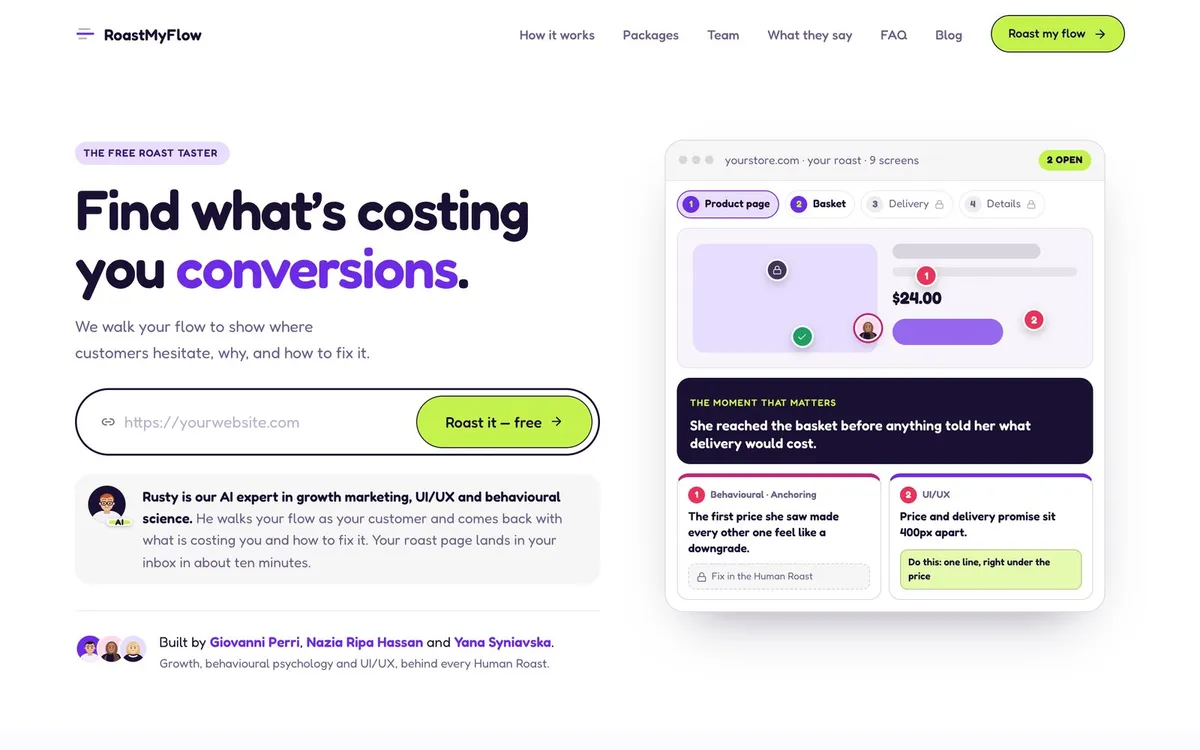
Most websites lose customers on a step that nobody on the team has clicked through for months. I wanted an AI agent to test website journeys the way a customer uses them, without waiting for a person to find the time. So I built one. It walks any flow on your website and shows you where your customer would hesitate, why, and how to fix it.
What does an AI agent that tests a website do?
An AI agent that tests a website opens it in a real browser and reads each page. It decides what to click or fill in, and it keeps going until it reaches the end of the journey. Along the way it writes down every moment where a real customer would slow down or give up.
That is what I do by hand at the start of every conversion project. I go through the client’s website as a customer would and write down where it hurts. I built RoastMyFlow to make that first walk repeatable. The agent inside it is called Rusty, and he is our AI expert in growth marketing, UI/UX and behavioural science.
The journey can be anything a customer does on your website. It can be a sign-up, a booking, a checkout or an intake form. You choose the flow, and he walks it.
How does Rusty know which flow to walk?
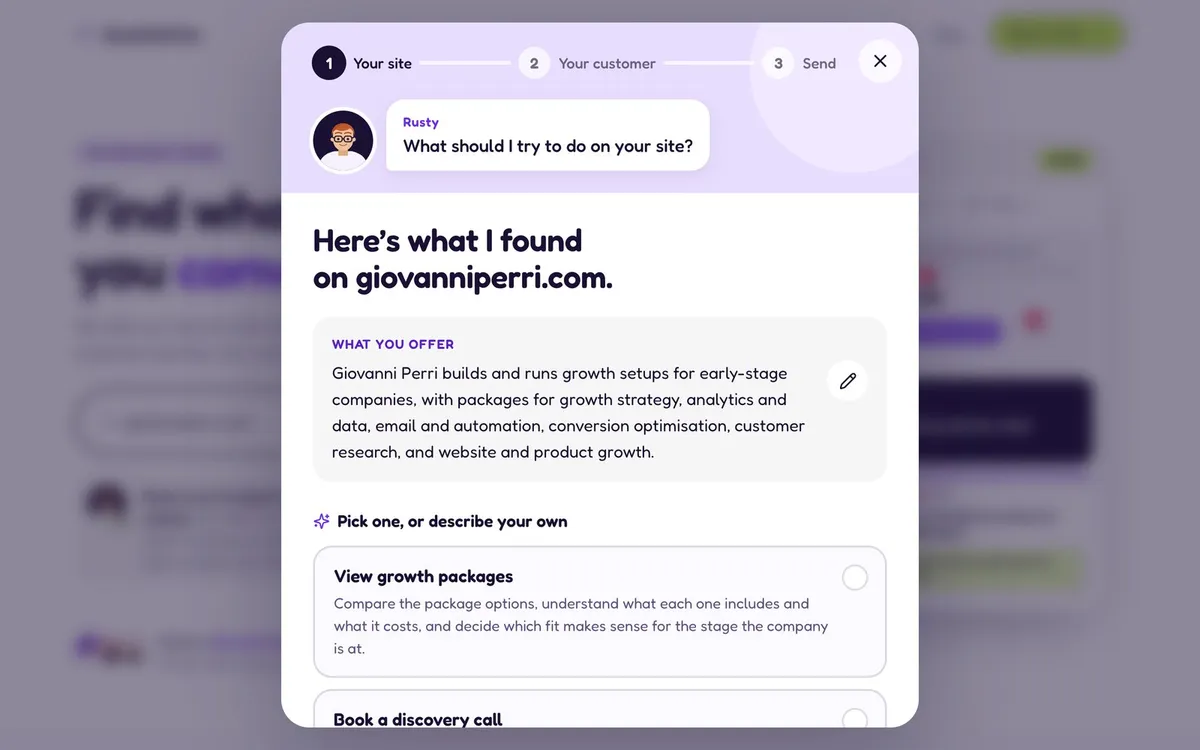
You only need to give Rusty your website. He reads your homepage, writes a short summary of what you offer, and suggests the journeys that matter most to your business. You pick one, or you describe your own.
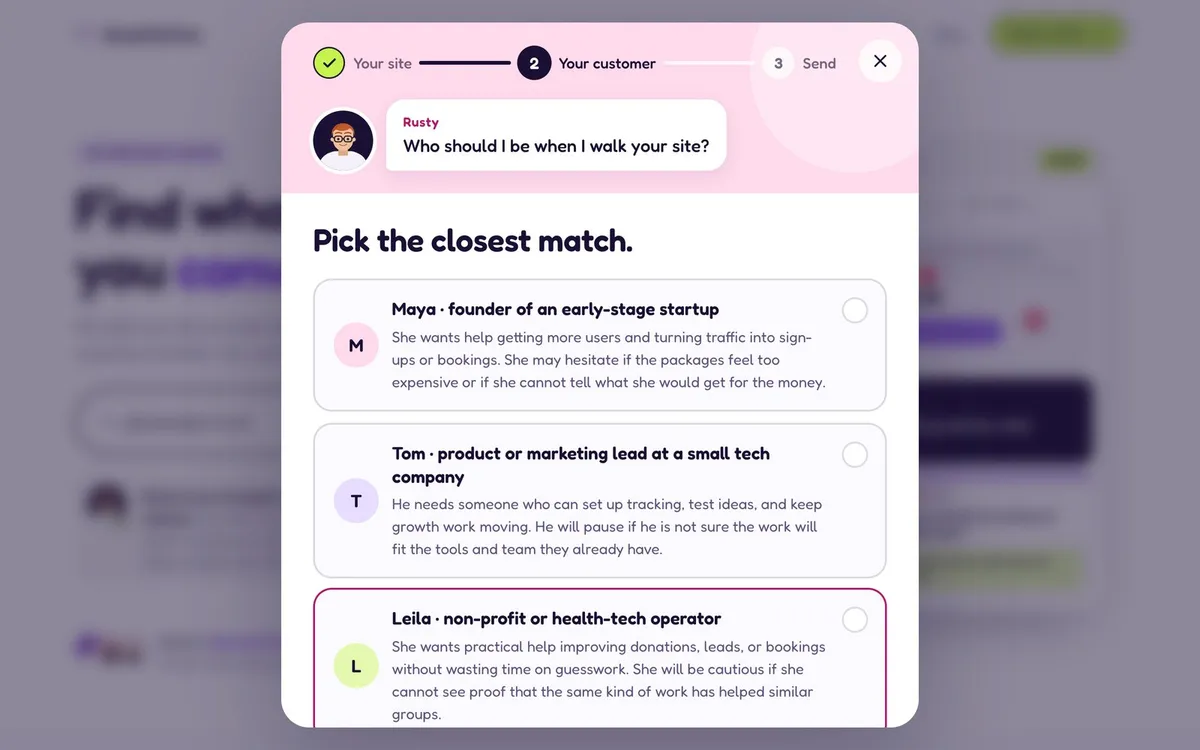
Then he asks who he should be. He suggests a few customers who fit your website, each with what they want and what would make them hesitate. That last part matters most, because a roast is only as good as the customer it is written for.
How did the agent learn to finish the journey?
My first version gave the agent a screenshot of each page and asked it where to click. It handled simple pages, and it struggled on the busy ones, such as a booking calendar with small green dots under the free days. A run took between 15 and 20 minutes.
The breakthrough was changing what the agent sees. Now it reads the page as text, with every button, link, field and calendar day listed with its name and state. Playwright, the tool that controls the browser, has a documented way to describe a page like this, and it is the same idea that screen readers use.
I then rebuilt the agent as its own small service in Python on top of Playwright. The first real run on a customer’s website finished in 125 seconds, all the way to the submitted form at the end. Today your roast page lands in your inbox in about ten minutes, with the report written and checked.
What do you get at the end of a roast?
You get a private roast page that walks you through your flow screen by screen. It opens with the moment that matters most, the point where your customer was most likely to stop. Under each screen you see how the customer felt there, and what Rusty found.
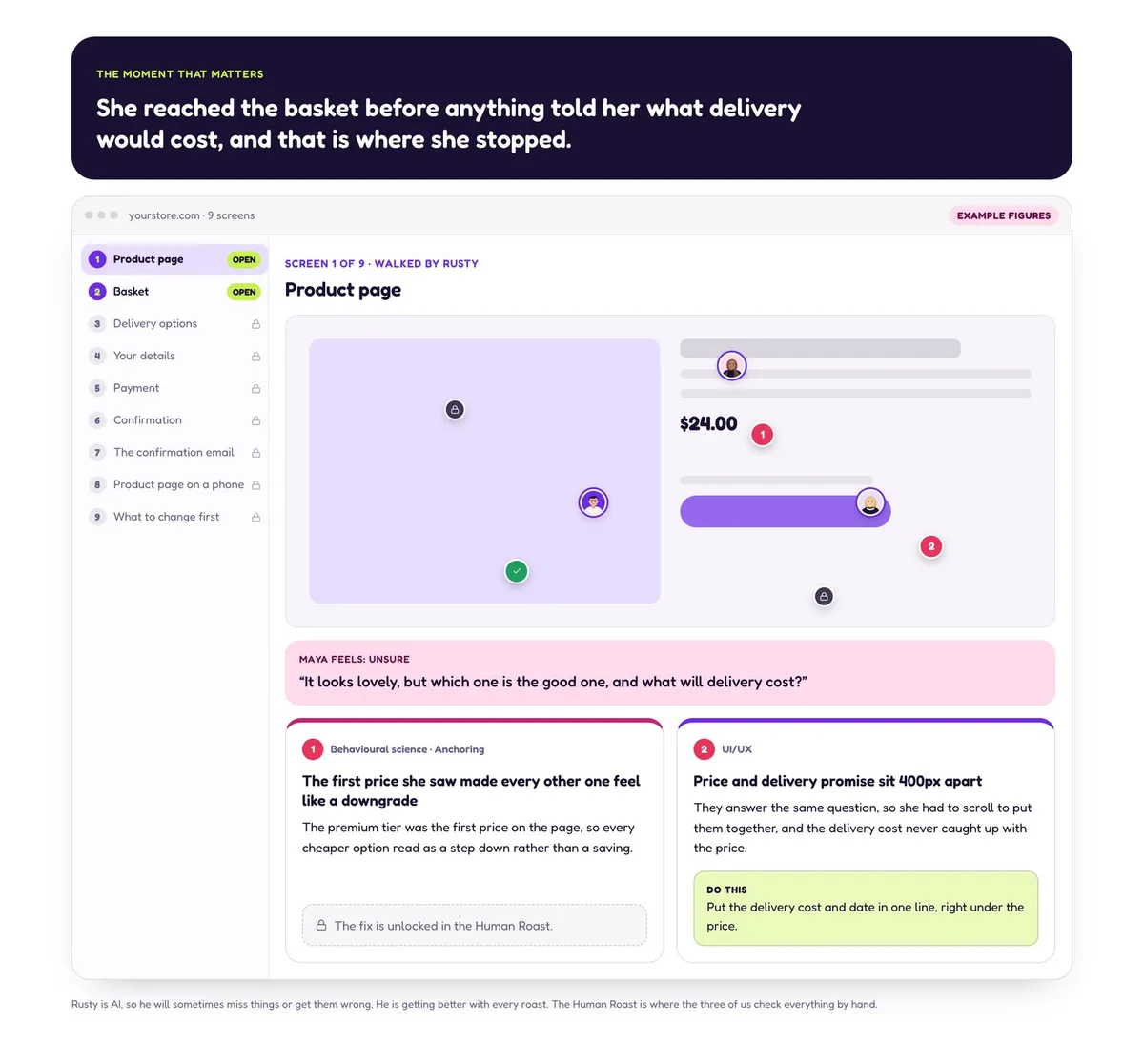
The free roast opens two findings in full: one from behavioural science and one more from growth or UI/UX. The rest are counted and stay locked for the Human Roast, where Nazia, Yana and I walk the same flow by hand and add what we find.
How does the agent keep getting better?
Every roast teaches us something. Nazia and I read the roasts that come in, and we mark which findings are right and useful. Those reviews became the benchmark that every change has to beat.
- New models are tested blind. When a new AI model comes out, I run it on real walks we have already reviewed and compare the results without knowing which is which. Only the winner goes live, and the report writer was upgraded this way on 2 October 2026.
- Every bug gets its own test. When the agent gets something wrong, I log it, fix it and add a test, so the same problem cannot come back unnoticed.
- The pages keep improving too. The intake, the roast page and the email have all been redesigned in the last few weeks, based on what people told us.
This is the part I enjoy most. The agent you use today is better than the one from last month, and next month’s will be better again.
How far will the agent go?
The person who requests a roast knows an AI will walk through their journey. So Rusty creates accounts, fills in forms and books appointments, because those are normal steps for a customer. The journey you describe tells him where to stop. If you say “stop before confirming”, he stops there and counts the journey as finished.
Payment is the one exception, and nothing you write can change it. Rusty never enters card details and never clicks anything that charges you or commits you to a paid plan. I put that rule in the code that checks every click, and I kept it out of the prompt on purpose, because a check in the code cannot be talked around.
Try it on your own website
If you want to see what Rusty finds, you can roast your flow for free at roastmyflow.ai. Your roast page arrives by email in about ten minutes. If it shows a leak that needs fixing, that is the kind of work I do for clients through my services. If you want to check the numbers behind your funnel first, I wrote about six checks I run on GA4, and you can read more about me.
I run RoastMyFlow with Nazia Ripa Hassan, and Yana Syniavska joins us on every Human Roast. I will keep sharing what we learn as Rusty improves.
an agent only helps once it can walk the journey your customer has to walk
Questions people ask
Can an AI agent really test a website like a customer?
Which flows can it walk?
Will the agent buy something on my website?
Is an AI website audit the same as a manual audit?
Written October 2026. Platform facts checked at the time of writing; if you are reading this much later, check them again.