If you searched for this job title, you probably found plenty of pages about fractional CMOs and very few about fractional Heads of Growth. That makes sense, because it is still quite a new title. It is also the job I do every week, so I thought I would explain how it works when I do it.
What does “fractional Head of Growth” mean?
A fractional Head of Growth is a senior person who leads a company’s growth part time, usually on a monthly package, instead of joining as a full-time employee. “Fractional” means you get a share of their week. “Head of Growth” means they own the growth numbers and the plan to move them.
In my case, that share is real. I work with three monthly clients at most, and I keep that limit on purpose. With more than three, the weekly sessions start slipping to every other week, and a broken step in the funnel can go unnoticed for a month.
Andrew Chen, who led growth at Uber, makes a point in his essay on hiring a Head of Growth that I agree with completely. The right growth lead depends on your stage. Once you have some traction, you need someone hands-on who can do the work, rather than an executive who manages managers. That is exactly the gap I work in.
What I actually do in a normal week
The heart of every engagement is the weekly growth session. We meet for an hour with the numbers on screen, look at what moved, and agree what happens next. Everything else I do follows from that meeting.
In a typical month, the work looks like this:
- One experiment finished and one started. Every test gets written up, win or lose, so you build a record of what works for your business. I explain how I make tests build on each other in this post on experiments.
- Measurement kept honest. I open Tag Manager, GA4 or Mixpanel myself. If a number looks wrong, I find out why before anyone makes a decision on it. These are the six checks I run on GA4 first.
- An email journey improved. That might be the welcome series, the activation emails or the win-back emails, depending on where people drop off.
- Briefs for the people doing specialist work. That means your designer, your developer or a paid ads specialist, and a proper check of their work when it comes back.
- A monthly report you can forward to your board as it is, and a quarterly session where we step back and look at the bigger plan.
I spend most of my time doing the work, and a smaller part of it managing the work. That balance is what makes the role different from a traditional marketing leader.
The two ways I work with a team
When I talk to founders, I only ask one question to work out how I would help. Is anyone doing marketing in house, even one person? The answer decides which of my two packages fits.
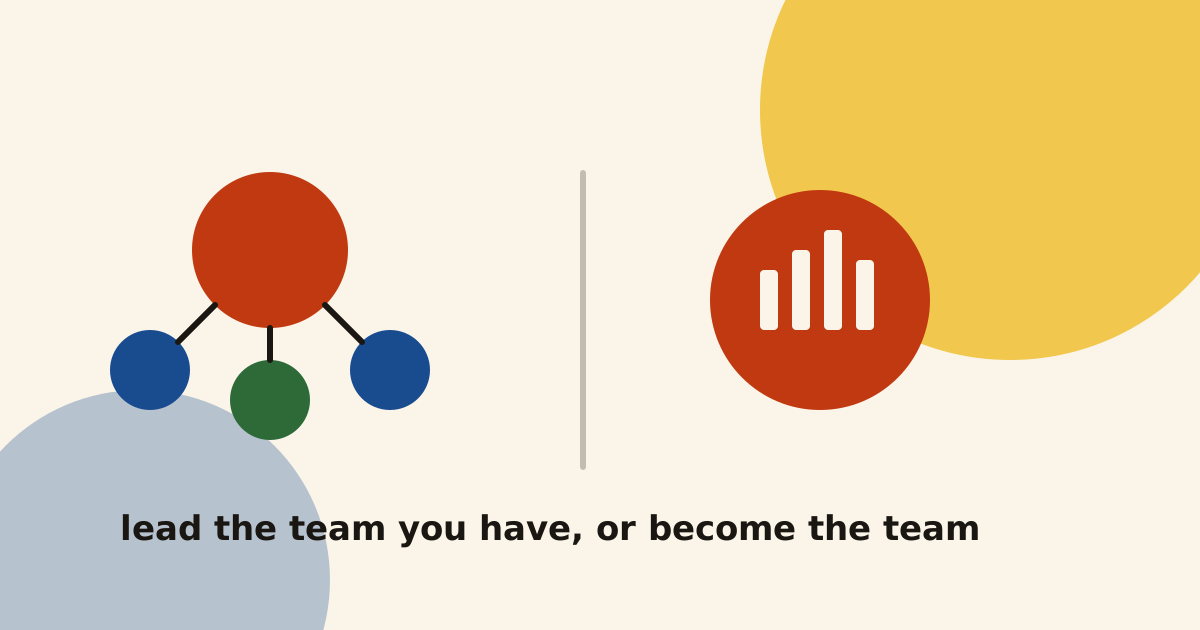
If you have a team, I lead it
This is my Growth Lead package. You already have a marketer, a designer or a developer, but nobody senior owns growth. I become that person.
Take a common job, like improving onboarding. I analyse the funnel, decide what to test, brief your designer and developer, set up the measurement, coordinate the launch and analyse the result. Your team builds the changes, and I make sure they are the right changes.
At Givergy, that meant working every week with their marketing manager, their PPC manager and their SEO manager. Together we chose the experiments, launched them and wrote up what we learned. The playbook we built kept running after I left, and that was the goal from the start.
If you do not have a team, I become it
This is my Growth Team package. It is for founder-led businesses where there is nobody else to brief. It might just be you, or you and one junior person.
Take the same onboarding job. This time I configure the tools, build the emails and the automation, make the changes I can make directly, launch it and analyse it myself.
I am not every discipline, and I will not pretend to be. When a job needs a real specialist, I bring in someone I trust and manage them for you.
At Augmentive I started by running Google Ads myself. After a couple of months I told the founder that the account needed a paid ads specialist more than it needed more of my time. I brought one in from my network, which freed me up for the analytics, email and testing work where I added the most.
Fractional CMO or fractional Head of Growth?
The two titles overlap, and plenty of people use them loosely. This is how I see the difference.
A fractional CMO usually owns the brand, the positioning, the marketing team and the marketing budget. The job is mostly about what the company says and where it says it.
A fractional Head of Growth owns the numbers across the whole journey, from the first visit to a paying customer who stays. The job is mostly about measurement, experiments, email journeys and product changes made with your developers.
A simple way to decide: if nobody can explain what your brand stands for, you probably want a CMO. If people arrive and do not convert, or convert and do not stay, you probably want a Head of Growth. If it is both, start with whichever problem is costing you more money right now.
When it is the right call, and when it is not
In my experience, a fractional Head of Growth is a good fit when:
- You have traction: paying customers, a channel or two that works, and a number you report to investors
- Nobody senior owns the growth numbers, the plan or the setup behind them
- A full-time Head of Growth is still a year away, and an agency feels too far from your product
- You want someone in your Slack who will actually open Tag Manager, and not just review the strategy
It is probably the wrong call when:
- You do not have a product people use yet. At that stage the founder is the best growth person, and Andrew Chen says the same in his essay.
- You need someone five days a week, in the office. Then it is time for a full-time hire, and I am happy to help you find one.
- You only need the setup built, once. That is a fixed project, and I run it as Growth Foundations. It covers the setup I build first and hands it over to your team.
What it costs with me
I put my prices on my website because I think you should know them before we speak. Growth Lead is £3,000 a month and Growth Team is £4,500 a month. Both start with a six-month term and a 30-day get-out, so if it is clearly not working in the first month, either of us can stop.
I do not charge by the hour or by the day. You pay for the work listed in the package, and I keep my client list small enough to deliver all of it.
How we would start
The first two weeks are always the same. We agree what to measure, what each event is called and whether the data can be trusted. If something is broken, I will tell you in the first week and we fix it before anything else. After that comes a written growth plan, the weekly session and the first experiments.
If this sounds like the gap in your company, have a look at how I work as a fractional Head of Growth, or book a thirty-minute call below. I will tell you honestly whether you need me, a full-time hire or nobody just yet.
if you have a team, I lead it, and if you do not, I become it
Questions people ask
Is a fractional Head of Growth the same as a consultant?
How many hours a week do I get?
How long does an engagement usually last?
Can a fractional Head of Growth help me hire a full-time team?
Written September 2026. Platform facts checked at the time of writing; if you are reading this much later, check them again.