
Most founders I speak to know they need senior help with marketing, but they are not sure when. If you hire too early, you pay for a plan you cannot act on, and if you hire too late, you spend another year guessing.
I have led growth part time for startups since 2018. These are the signs I look for when a founder asks me when to hire a fractional CMO.
When should you hire a fractional CMO?
You should hire a fractional CMO when your company has some traction, nobody senior owns marketing, and there is not yet enough senior work for a full-time hire. A fractional CMO gives you a share of an experienced person’s week, usually on a monthly package.
I should be honest about one thing before the checklist. I lead growth for clients through Run, my fractional Head of Growth service, and that is a slightly different job from a classic CMO. I explain the difference further down, because it matters for who you hire. The seven signs work for both roles, so you can use them to decide whether you need senior marketing help at all.
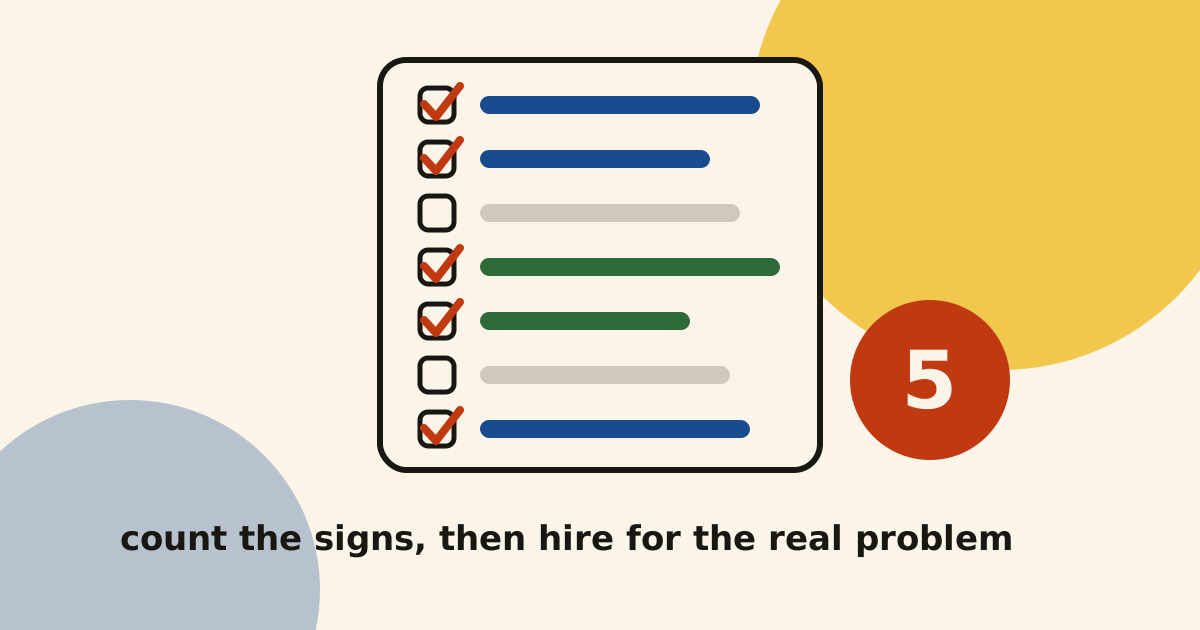
The seven signs, as a checklist
Read each sign and give yourself one point if it is true for your company today. Be strict with yourself. “Sort of true” counts as zero.
- You have paying customers and at least one channel that brings them in. It might be search, paid ads, referrals or partnerships. If nothing works yet, a senior marketer has nothing to build on.
- Nobody senior owns the marketing numbers. The founder looks at them when there is time, and everyone else looks at their own part. Nobody can say which number matters most this quarter.
- People in the company disagree about what the numbers say. Sales has one figure, marketing has another, and the dashboard has a third. At Qured, the first real step forward was agreeing in writing what a booking was.
- You have people doing marketing, but nobody gives them direction. You might have a junior marketer, a designer, a developer or a few freelancers. They are busy, but nobody senior decides what they work on or checks it from a growth point of view.
- The founder is still doing most of the marketing at night. That was the right thing to do at the start. Once you have traction, it takes time away from the product, the team and fundraising.
- You are spending money on marketing, but you cannot say what is working. That could be ad spend, an agency or a set of tools. If nobody can tell you which part pays for itself, you are probably wasting some of it.
- A full-time senior hire is still about a year away. You may not have the budget yet, or there may not be five days a week of senior work. Either way, you need the thinking now and the full-time person later.
What your score means
Add up your points. This is how I would read the result if you told it to me on a call.
- Zero to two: it is probably too early. The best person to find your next customers is still you. Keep going, and spend the money on the product. If one specific job is blocking you, such as tracking you cannot trust, a single fixed project is a better fit than a monthly lead.
- Three or four: it is worth a conversation. Some of the gaps are real, but a monthly lead may be more than you need. Often the right first step is to fix the setup underneath, and a monthly lead comes later.
- Five to seven: it is time. You have enough traction for a senior person to work with, and enough gaps for them to fill. The remaining question is which kind of senior person, and the next section helps with that.
Do you need a fractional CMO or a fractional Head of Growth?
The two titles overlap, and plenty of people use them loosely. In my view, the difference is the problem each one is there to solve.
A fractional CMO usually owns the brand, the positioning, the marketing team and the marketing budget. The job is mostly about what the company says and where it says it.
A fractional Head of Growth owns the numbers across the whole journey, from the first visit to a paying customer who stays. The job is mostly about measurement, experiments, email journeys and product changes made with your developers. That is the job I do, and I describe a normal week in my post on what a fractional Head of Growth does.
Your checklist can help you tell which one you need:
- If your team is busy but nobody can explain what your brand stands for, you probably want a CMO.
- If your points came mostly from signs three and six, and people arrive but do not buy, or buy and do not stay, you probably want a Head of Growth.
- If it is both, start with whichever problem is costing you more money right now.
If you call me and the problem is really your brand, I will tell you so. I would rather point you to the right person than take on work that someone else would do better.
Fractional CMO vs full-time: which one fits now?
A full-time CMO or Head of Growth gives you a whole person, every day. A fractional lead gives you a share of their week. Neither is better in general. The right one depends on how much senior work there really is in your company today.
In my experience, full time is the better choice when:
- There is enough senior marketing work for five days a week
- You need the person in the office, or in every meeting, every day
- You already have a team of several marketers who need a manager
Fractional is the better choice when:
- There is only enough senior work for a share of a week
- You need someone who will do much of the work as well as plan it
- You want help now, while the full-time hire is still a year away
Andrew Chen, who led growth at Uber, makes a related point in his essay on hiring a Head of Growth. He warns against hiring an executive who manages managers too early. A smaller company needs someone hands-on who moves the numbers every week.
If cost is part of the decision, I compare UK fractional rates with a full-time salary in my post on what a fractional CMO costs. My own prices are on the site: my monthly service starts at £3,000 a month, and it is usually £4,500 if you have nobody in marketing. I take three monthly clients at most.
When it is the right call, and when it is not
A fractional lead is the right call when you scored five or more and the main gap is senior ownership. That is the situation I work in every week.
It is probably the wrong call in a few situations:
- You do not have a product that people use yet. Paul Graham argues in Do Things that Don’t Scale that founders have to recruit their first users themselves. I agree, and no senior hire can do that part for you.
- You only need the setup built, once. That is a fixed project, and I run it as a Build. You get the tracking, the tools and the email journeys built and handed over to your team.
- You need one specific piece of work. A tracking check is what the Audit is for, and a single automation is a fixed-price Build. Neither needs a monthly lead.
- You expect someone else to own growth completely. Even with a great lead, the founder still needs to give the work time and attention. A fractional lead works alongside you, and you stay involved.
At Augmentive, I started by running Google Ads and landing pages. Over time the work grew into email journeys for both sides of the marketplace, regular experiments and a rebuilt sales process. The work grew because the company was ready for it, and the checklist above is how I would judge that readiness today.
How we would start
If you scored five or more, or you are sitting on three or four and want a second opinion, I am happy to look at it with you. You can read how I work as a fractional Head of Growth, or book a discovery call below.
Bring your score to the call. I will tell you honestly whether you need me, a fractional CMO, a full-time hire or nobody just yet.
count the signs honestly, then hire for the problem that costs you most
Questions people ask
When is it too early to hire a fractional CMO?
Fractional CMO vs full-time: which one should I choose?
Is a fractional Head of Growth the same as a fractional CMO?
How long does it take before a fractional lead makes a difference?

I build growth systems with AI for UK and English-speaking startups, then run them with your team or on my own. More about me · how I work.
Written November 2026. Platform facts checked at the time of writing; if you are reading this much later, check them again.